
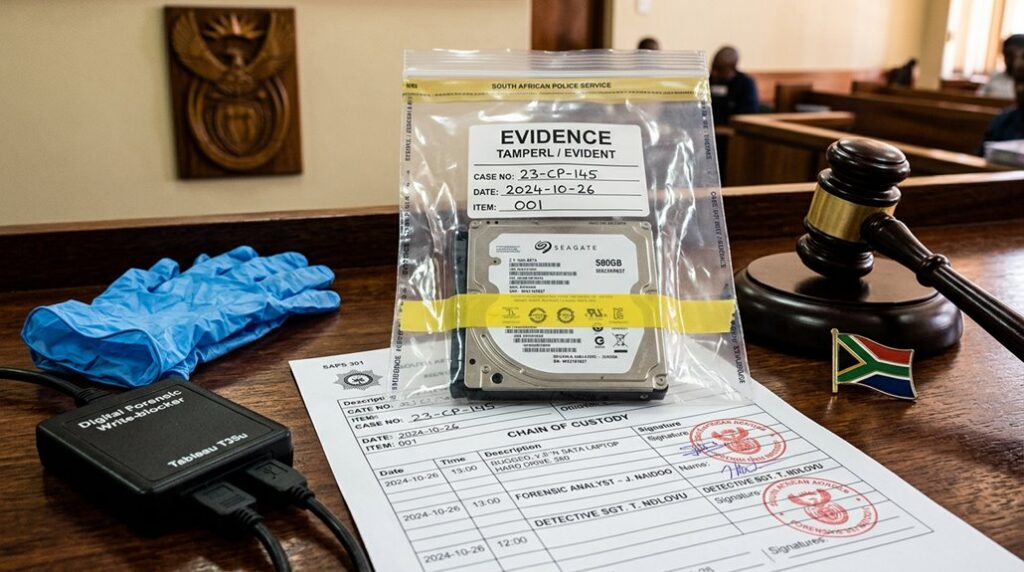
Digital evidence appears in roughly 90% of South African criminal cases — yet most investigators still get the chain of custody wrong. The Cybercrimes Act, Criminal Procedure Act, and Electronic Communications and Transactions Act each impose obligations that, when ignored, collapse an entire prosecution. One misstep between collection and courtroom, and perfectly valid evidence becomes legally worthless. Understanding exactly where that chain breaks is not optional for anyone handling digital evidence in South Africa.
What Chain of Custody Actually Means for Digital Evidence?
At the heart of any digital investigation lies a structured process known as chain of custody. This legal chain of custody functions as a chronological record. It documents every movement and handling of digital evidence from initial seizure through court presentation.
The primary purpose is clear: proving that evidence remained unaltered and secure throughout the investigative process. Courts in South Africa require this demonstration without exception. Prosecution must show that digital evidence South Africa cases rely on was never interfered with between seizure and trial. Adherence to the Electronic Communications and Transactions Act ensures that evidence acquisition methods meet the statutory requirements necessary for legal defensibility in South African proceedings.
Digital forensic investigators bear direct responsibility for maintaining evidence security during analysis. Admissibility depends entirely on establishing that standard procedures were followed correctly. An unbroken chain of custody gives legal teams measurable control over evidence reliability in formal proceedings. Internationally recognised frameworks such as ISO/IEC 27037 provide guiding principles for the proper handling, acquisition, and preservation of digital evidence to support this process.
How South African Law Controls the Seizure of Digital Devices
South African law establishes a clear legal structure governing how digital devices may be seized during criminal investigations. The Cybercrimes Act 19 of 2020, sections 28 and 29, together with the Criminal Procedure Act 51 of 1977, sections 21 through 23, provide this authority. Search warrants must be obtained before any seizure occurs.
Section 25 of the Cybercrimes Act defines “seize” to include copying data, as well as taking physical possession. This definition directly supports electronic data admissibility by allowing forensic duplicates to substitute for original devices. Investigators must apply cryptographic hash verification to confirm that copied data remains unaltered.
Original devices should only be retained when on-scene duplication is impossible. Retaining devices beyond predetermined periods requires formal magistrate approval. These controls ensure that evidence integrity remains uncompromised. Throughout this process, investigators must maintain an unbroken chain of custody for all digital evidence to ensure forensic findings remain legally admissible during disciplinary hearings and litigation support proceedings.
Chain of Custody Documentation and Storage Requirements
Once lawful seizure of digital devices has occurred, the legal obligation shifts immediately to maintaining a verifiable chain of custody. Every seized item requires a unique identifier for tracking throughout all custody stages. Chronological records must document every movement, access event, and personnel interaction from seizure through court presentation.
Physical hardware storage must meet strict environmental standards. Facilities must eliminate exposure to extreme temperatures, humidity, magnetic sources, and dust. Evidence contamination risks increase markedly when storage conditions fall outside these controlled parameters.
Documentation must follow affidavit format, satisfying ISO/IEC DIS 27037 Standard requirements. Records must capture who accessed evidence, when, and where. Any changes made to evidence require written justification. Proper booking into the SAPS13 register remains mandatory for all seized cyber articles.
Defensible evidence processing preserves exact system states and volatile electronic information, ensuring that digital evidence remains admissible and withstands legal scrutiny throughout court proceedings.
What Breaks Chain of Custody in South African Courts?
In South African courts, digital evidence loses its legal standing when chain-of-custody protocols are violated at any stage. #ChainOfCustodyBreaches occur through physical mishandling, improper storage, and unauthorised device activation. Remote wipe risks and metadata destruction follow inadvertent power changes.
| Breach Category | Consequence |
|---|---|
| Unauthorised device handling | Evidence inadmissibility |
| Power management failures | Irreversible metadata loss |
| Environmental storage damage | Compromised integrity |
#UnauthorizedAccessRecords represent a critical failure point. Missing check-in and check-out documentation creates gaps courts cannot overlook. Investigators exceeding search warrant scope further compromise admissibility. Advanced keyword searching can expose hidden communication patterns and identify key custodians, reinforcing the integrity of the evidentiary record when properly documented.
Proper control requires documented authorisation for every evidence interaction. Unique identifiers and continuous custody records protect evidentiary reliability. Seized device handling risks such as inadvertently powering devices on or off can compromise metadata or trigger remote wipes, potentially rendering evidence inadmissible under South African law. Maintaining strict procedural compliance produces the great result of legally defensible digital evidence.
Legal Consequences When Chain of Custody Is Compromised
When chain of custody is compromised, three core legal consequences emerge in South African proceedings: outright exclusion of evidence, reduced probative value, or weakened expert testimony.
Courts assess whether authentication failures have affected data reliability rather than applying automatic exclusion. The prosecution bears the burden of proving an intact chain of custody.
Compromised custody creates measurable risks that undermine control over outcomes:
- Evidence excluded entirely, removing critical forensic duplicates from proceedings
- Authentication failures exposed, where improper handling destroys hash value verification and data integrity
- Expert testimony weakened, reducing the evidentiary weight courts assign to digital findings
South African jurisprudence recognises that a broken chain of custody does not automatically render evidence inadmissible.
However, reduced probative value remains a highly advantageous result for opposing counsel, creating unpredictable litigation exposure. Organisations can reduce this exposure by implementing digital evidence management systems that secure and preserve electronic information according to verified forensic protocols from the outset of an investigation.



