
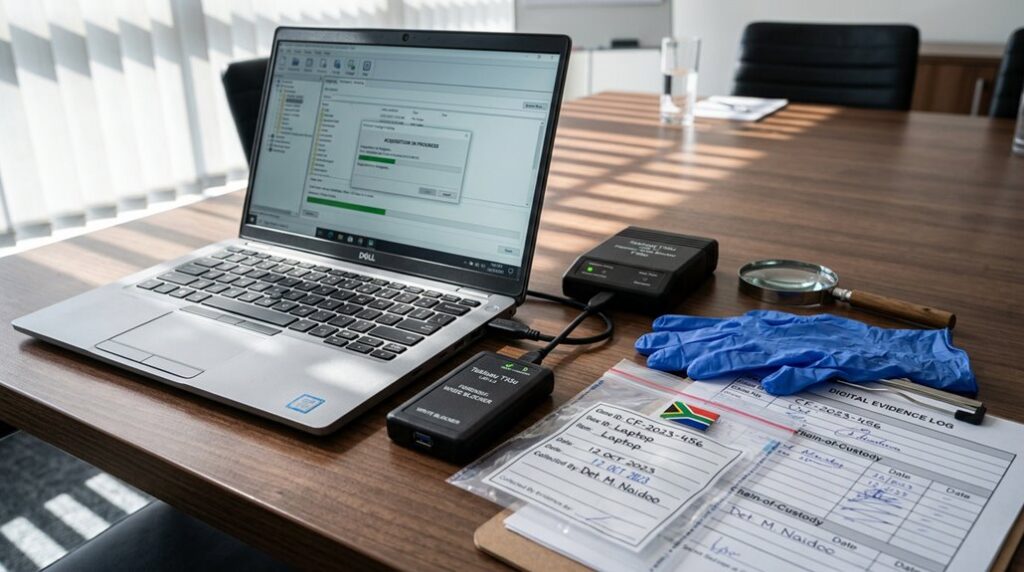
Most employers believe a signed IT policy is enough to access a work laptop legally. It is not. South African law imposes two distinct requirements before any evidence extraction is lawful, and failing either one can collapse a disciplinary case entirely — or trigger a POPIA complaint against the very company that thought it was protected. The legal trap is not obvious, and it catches experienced HR teams just as often as it catches small businesses.
RICA and POPIA Requirements Before Accessing a Company Laptop
Before accessing a company laptop in South Africa, employers must satisfy two distinct legal frameworks: the Regulation of Interception of Communications and Provision of Communication-Related Information Act (RICA) and the Protection of Personal Information Act (POPIA). Both regimes govern how electronic evidence is handled before, during, and after extraction.
RICA requires either written employee consent under Section 5 or a legitimate business purpose under Section 6. Employees must receive advance notification that company communications may be monitored. POPIA then regulates what happens to extracted data, requiring a lawful basis for processing and strict minimality.
Maintaining a defensible chain of custody for electronic evidence depends on satisfying both regimes before any access occurs. Non-compliance invalidates evidence and exposes employers to serious legal liability. Forensic imaging of the device before any access occurs preserves data in its original form and prevents accusations of tampering or manipulation. Engaging a qualified digital forensics specialist ensures that chain of custody documentation is established and maintained in a manner that will withstand scrutiny in South African courts.
How Forensic Imaging and Write-Blocking Keep Your Evidence Clean
Forensic imaging produces an exact, bit-for-bit copy of every sector on a hard drive, capturing deleted files, metadata, and unallocated space simultaneously.
Write-blocker devices place the original drive in read-only mode before any copying begins, preventing investigator actions such as opening, closing, or searching files from altering stored data. Adherence to the Electronic Communications and Transactions Act and the use of write-blocking hardware during acquisition ensures that evidence processing remains legally defensible throughout the investigation.
South African courts, CCMA hearings, and Labour Court proceedings assess evidence admissibility based on documented procedural integrity, meaning a compromised chain of custody or modified metadata can render an entire investigation inadmissible. Industry standards such as ISO/IEC 27037 provide internationally recognised guidelines for the identification, collection, acquisition, and preservation of digital evidence to support this integrity.
What Is Forensic Imaging
At the heart of any sound digital investigation lies a process called forensic imaging. This forensic laptop imaging methodology creates a sector-by-sector, bit-by-bit duplicate of a storage device. Every piece of data is captured, including deleted files and empty space.
The process produces an exact replica of the original drive. Investigators work exclusively on this copy, leaving the source device completely untouched. This separation protects original evidence from accidental alteration.
Forensic imaging differs from standard file copying. A regular copy transfers visible files only. Forensic imaging captures everything the storage medium contains, regardless of whether the operating system recognises it. Evidence preservation protocols ensure that both documentary and electronic footprints remain intact and admissible throughout the investigative process.
Validated software applications execute this process. Commonly used tools include FTK Imager, EnCase Forensic, and Linux-based alternatives such as dd and Guymager. Each tool produces legally defensible, court-ready evidence. A hardware write-blocker must be connected between the source device and the forensic workstation to prevent any write commands from reaching the original drive.
Write-Blockers Prevent Tampering
Every write blocker sits in the data path between an evidence drive and a forensic workstation, acting as a command filter. It examines every command the host computer sends. Read commands pass through freely. Write, format, and modify commands are silently discarded.
This workplace digital forensics procedure guarantees the operating system cannot alter evidence invisibly. Protection activates upon drive connection, not after imaging software opens.
Hardware write blockers, manufactured by Tableau and WiebeTech, meet South African, US, and UK court standards. They physically prevent write commands from reaching source disks. Examiner error cannot circumvent them.
Function testing validates each unit before acquisition. Pre- and post-test SHA-256 and MD5 hash values must match exactly. Documented results confirm the blocker performed correctly, a great result for any litigation-bound case. Maintaining an unyielding chain of custody throughout this process ensures that hash-verified evidence retains its legal standing when submitted to South African courts.
The write-blocked drive is then used to create a bit-by-bit image, capturing an exact snapshot of the data as it existed at the moment of collection, preserving its forensic integrity for admissibility under the Electronic Communications and Transactions Act 2002.
Admissibility Depends On Integrity
Write-blockers preserve the integrity of source drives during acquisition. This hardware barrier prevents any write commands from reaching the original device during a corporate digital forensics investigation. Cryptographic hash verification, typically SHA-256, then confirms the forensic copy matches the original at the binary level.
Admissibility depends entirely on this integrity chain. South African courts, CCMA hearings, and Labour Court disputes will exclude evidence when chain of custody documentation contains gaps. Every access event requires logging, from initial collection through courtroom presentation. Maintaining a strict chain of custody ensures that each transfer and access point is defensibly documented from the moment of collection through to final production.
Breaks in procedure override technical validity. Even perfectly captured data becomes inadmissible if handling protocols fail. ISO/IEC 27037 compliance provides the defensible structure. Acquisition must also capture all associated metadata, including EXIF data, in its original state to prevent undetected modification after capture.
- Bit-for-bit accuracy captures deleted files and system artefacts
- Periodic hash checks confirm storage integrity
- Documented preservation methods satisfy South African admissibility standards
How to Extract Evidence From a Work Laptop Legally
Extracting evidence from a work laptop legally requires employers to first establish lawful grounds under POPIA and RICA before any data collection begins.
Employment contracts and workplace policies must document consent for device inspection, specifying circumstances such as suspected misconduct, data theft, or intellectual property misuse. Forensic technology consulting can further support this process by delivering independent digital risk assessments that identify structural weaknesses before an investigation becomes necessary.
Once lawful grounds are confirmed, a qualified digital forensic professional must perform forensic imaging before accessing any files, followed by targeted data collection limited strictly to information relevant to the investigation. Searches must remain reasonable and proportionate to the legitimate business need being investigated.
Establish Lawful Interception Grounds
Before extracting any data from a company laptop, employers and their appointed forensic specialists must establish lawful interception grounds under South Africa’s Regulation of Interception of Communications and Provision of Communication-Related Information Act (RICA). Three distinct legal pathways exist. Each pathway determines CCMA digital evidence admissibility.
| RICA Provision | Key Requirement |
|---|---|
| Section 4 – Party Exception | Employer participates directly in communication |
| Section 5 – Written Consent | Employee signs prior written consent |
| Section 6 – Business Purpose | System controller documents authorisation |
| Section 6 – Reasonable Notice | Workplace policy notifies users of monitoring |
| Section 6 – Legitimate Need | Investigation connects to specific misconduct |
Selecting the correct pathway before extraction begins protects evidence integrity. Missteps invalidate findings entirely. Organisations that lack clearly documented internal governance frameworks expose themselves to evidentiary challenges that corporate compliance risk advisory specialists are specifically positioned to prevent.
Conduct Forensic Imaging First
At the moment of device seizure, forensic imaging must be the first technical step taken before any inspection or analysis begins. An independent computer forensics expert performs a bit-by-bit physical clone of the entire storage medium. This captures all data, including deleted files, in its original, unaltered state.
Write-blocking hardware connects between the device and imaging equipment, preventing any modification during extraction. This satisfies requirements under sections 14 and 15 of the Electronic Communications and Transactions Act 25 of 2002. A correctly produced forensic duplicate is legally recognised as an original.
This process documents the exact device state at seizure, creating an auditable chain of custody. Employers gain defensible evidence while protecting themselves from privacy violation or unlawful interception claims. Ensuring digital evidence admissibility in South African litigation requires that the imaging process be conducted by a qualified forensic specialist operating within a documented, verifiable methodology.
Limit Data Collection Scope
Within any legitimate workplace investigation, limiting the scope of data collection is not optional — it is a legal obligation under South African law. An employee computer misconduct investigation must target specific data, not entire device contents.
Investigators must define exact parameters before extraction begins. These include:
- Specific file types relevant to the allegation
- Defined date ranges matching the suspected misconduct period
- Named projects, communications, or subject matter only
Broad “dragnet” searches constitute unlawful fishing expeditions under South African jurisprudence. Courts reject evidence collected without precise justification.
The Protection of Personal Information Act (POPIA) requires proportionality at every stage. Metadata and timestamps should be reviewed first, escalating to full content access only when strictly necessary. Structural fraud detection protocols identify critical anomalies that help investigators justify and narrow the precise scope of data collection before extraction begins. This disciplined approach produces legally defensible, admissible evidence.
Chain of Custody Rules That Determine CCMA Admissibility
When evidence from a work laptop enters a CCMA proceeding, its admissibility depends entirely on chain of custody documentation. Proving employee data theft requires an unbroken record of who handled the device, when, and under what conditions.
Every transfer of evidence demands signed documentation noting the date, time, and condition of the device. Gaps in these records create vulnerabilities that opposing parties will exploit.
Every evidence transfer demands signed documentation — because gaps in records become opportunities for opposing parties.
Key documentation requirements include:
- Timestamps for every instance of evidence access
- Identified custodians at each handling stage
- Access logs recording all personnel present
Hash values and verification checksums confirm the forensic image matches original device data exactly. This verification prevents tampering accusations. Evidence presented without complete chain of custody records risks rejection before the CCMA even considers its contents. Independent general forensics specialists can provide the objective documentation and verified chain of custody records necessary to withstand scrutiny during misconduct investigations and CCMA proceedings.
Company Devices vs Personal Devices: Where Your Legal Authority Ends
The legal authority an employer holds over a work laptop differs substantially from any authority claimed over an employee’s personal device. Knowing how to legally extract evidence from work laptop investigations requires grasping this boundary clearly.
Key distinctions that define employer authority:
- Company-owned devices carry stronger legal inspection rights than personal phones or laptops
- Section 14 of the Constitution protects privacy, but that protection weakens for employer-owned equipment
- Personal devices demand lawful justification, informed consent, or contractual rights before any access
- Mere suspicion of misconduct does not automatically justify seizing a personal device
Exceeding this boundary creates serious legal exposure. Courts examine whether the search scope matched the legitimate business objective. Proportionality matters. Employers who overreach risk evidence being excluded entirely, undermining disciplinary proceedings before they begin.
What Happens When Forensic Evidence Is Challenged at the CCMA
Forensic evidence extracted from a work laptop faces serious scrutiny once it reaches the Commission for Conciliation, Mediation and Arbitration (CCMA). Arbitrators examine collection methodology closely. Improperly handled evidence loses admissibility entirely.
Common challenge grounds include:
- Screenshots lacking metadata
- Incomplete conversation extracts
- Missing authorisation documentation
- No qualified forensic professional involvement
The employer bears full responsibility for proving evidence reliability. Failure shifts the evidentiary burden unfavourably. A successful challenge results in dismissal reversal and compensation awards.
Businesses operating from Centurion, South Africa, and surrounding regions benefit greatly from engaging independent forensic specialists before initiating disciplinary proceedings. Proper chain of custody documentation, bit-by-bit imaging, and expert testimony produce a great result. These measures satisfy the balance of probabilities standard arbitrators apply.



